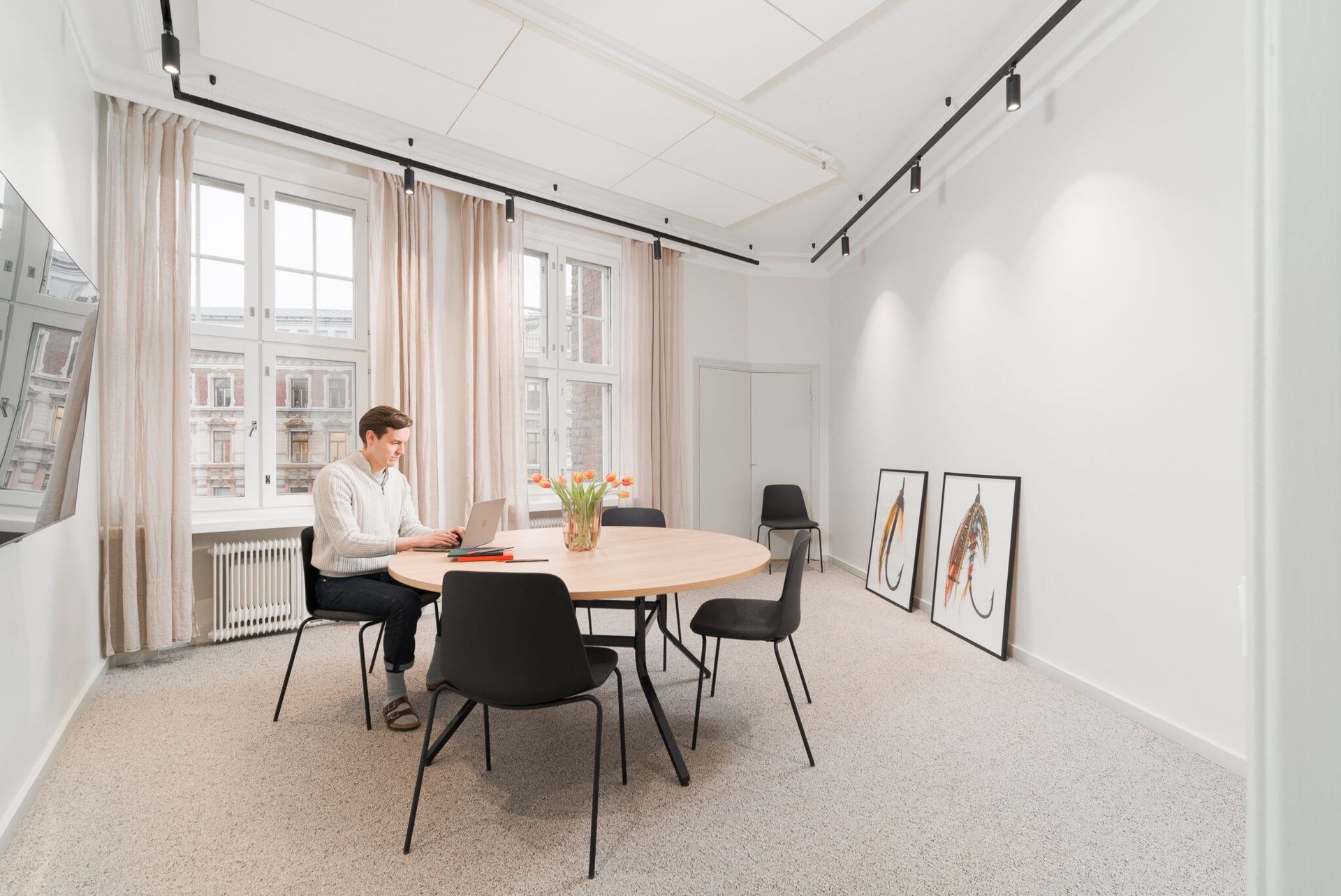
Open-plan offices
still get this wrong.
Light and sightlines get specified first. Acoustics gets specified last, if at all. That ordering is why so many nice-looking offices are hard to think in.
Light and sightlines get specified first. Acoustics gets specified last, if at all. That ordering is why so many nice-looking offices are hard to think in.
Walk into most open-plan offices built in the last ten years and you'll find the same brief was followed: exposed ceilings for height, hard flooring for durability, glass partitions for light. Every one of those choices is reasonable on its own. Stacked together, they remove nearly every soft surface a room had to absorb sound with.
The result isn't usually described as a noise problem — it's described as a focus problem, a meeting-room-booking problem, a "why does everyone wear headphones" problem. Reverberation time is rarely the first thing anyone blames, because it's invisible. You don't see an untreated ceiling being loud. You just notice, gradually, that a call in the corner of the room is audible from your desk, and that a five-minute conversation two desks over derails your afternoon.
Most workplace-wellbeing initiatives aimed at noise — quiet hours, phone booths, "library mode" — are attempts to manage behaviour around a room that isn't doing its job. They help, but they're working against the space rather than with it. A ceiling with real absorption changes the baseline: speech decays faster, background noise doesn't build across the day, and a raised voice two rows away stays a background hum instead of a distraction.
The metric that matters here is reverberation time — how long it takes sound to decay by 60 dB after the source stops. Building codes set targets for it depending on room use, but an untreated open-plan office with a hard ceiling will typically sail past those targets. Add a Class A absorber across the ceiling plane and the decay time drops sharply, usually enough on its own to bring a room back into a comfortable range without touching the floor or the walls.
The reason acoustic treatment got specified last for so long is that it used to look like acoustic treatment — perforated panels, visible batting, an obviously "acoustic" texture bolted onto an otherwise finished ceiling. That trade-off is what pushed it to the bottom of the brief. A tile that reads as a plain, neutral surface removes the trade-off entirely: architects get the flat, quiet ceiling they specified for the render, and it happens to also solve the problem nobody wanted to add a line item for.